
WiFi 7’s 320 MHz Channels: Benefits and Who Might Need Them
WiFi 7’s ultra-wide 320 MHz channels increase transmission capacity and use the less congested 6 GHz band. Their benefits may matter most for emerging demanding applications, while earlier WiFi generations can still meet many everyday needs.
What We Know
WiFi channel widths have expanded alongside successive wireless standards. WiFi 5 introduced 160 MHz channels, with room for only two on the 5 GHz band. WiFi 6 allows channels to be divided into smaller subcarriers so resources can be allocated more efficiently among devices.
WiFi 6E introduced the 6 GHz band, which avoids congestion from legacy devices and supports seven simultaneous 160 MHz channels. The next step, WiFi 7, brings ultra-wide 320 MHz channels—but whether you need them depends on how you use your network.
Understanding 320 MHz channels
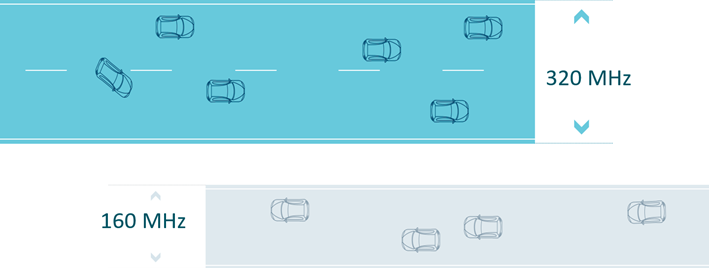
Think of data as traffic and channel width as road capacity. An 80 MHz channel resembles a neighbourhood street, a 160 MHz channel a 4-lane road, and a WiFi 7 320 MHz channel an 8-lane superhighway. More lanes let more information travel at once, easing heavy traffic.
What wider channels offer
- More throughput: 320 MHz provides 4 times the throughput of 80 MHz and 2 times that of 160 MHz, doubling the transmission capacity of WiFi 6 and 6E.
- Lower delays and higher transmission rates: Wider channels help reduce delays. WiFi 7’s maximum theoretical rate can reach 46 Gbps.
- Less interference: 320 MHz channels operate in the more open 6 GHz band, away from the bands used by the most common wireless transmission protocols.
Do you need 320 MHz WiFi?
Earlier WiFi generations may already provide enough speed for your daily activities. Improvements between standards can be difficult to notice individually, yet their cumulative effects can change what people do online.
For example, a little over 10 years after 1080p streaming became possible, 4K video is gradually becoming mainstream. Online games also offer sharper graphics and support more players than before.
Working and studying from home during COVID-19 highlighted the importance of fast, reliable WiFi. The progression from WiFi 5 through WiFi 6 and WiFi 6E helped make that connectivity easier.
WiFi 7 will likewise change network usage habits. Potential future applications include higher-definition 8K live streaming and large-scale AR/VR online gaming. For enterprises and governments, it can also support more efficient offices, smart security management and telemedicine services.

